
No Time, No Space
Jesse James Ferrell on the album that ended a year of becoming worthy.

U N T A M E D T A L K S
Content note: This conversation touches grief, estrangement, and a night the artist came close to not staying. It is told from the far side of that night. If it finds you on a hard one, the song “The Boarded Door” — and this interview — were built to hold you, not to frighten you. Resources are at the close.
— ◆ —
When this album comes on and you forget you made it — what does your body do first?
It exhales before I do. There’s a breath the whole record is built on — every track opens with a little instrumental space on purpose, room before the voice — and my body finds that breath before my mind remembers I’m the one who put it there. But I feel it in my heart first.
This album came out of a falling-out with my grown children and their mother. There was a Tuesday in October of 2016 when I said things I couldn’t take back, and by the time I understood the damage, my kids were already deeply wounded. I came apart. They had always been my guiding light — everything else I get to do in this life is the beautiful byproduct of being their father.
“The Boarded Door” is that day. It’s the day I wanted to run into traffic and end my life. And then a strange, curious thought rose up out of the dark: what if I lived to prove them wrong — not that they were wrong about me, but that the way I had been living was not the best version of who I was becoming. So I dedicated myself to finding out who I actually am. Years of medicine work to heal myself, my family, my ancestral line, and the generations coming after.
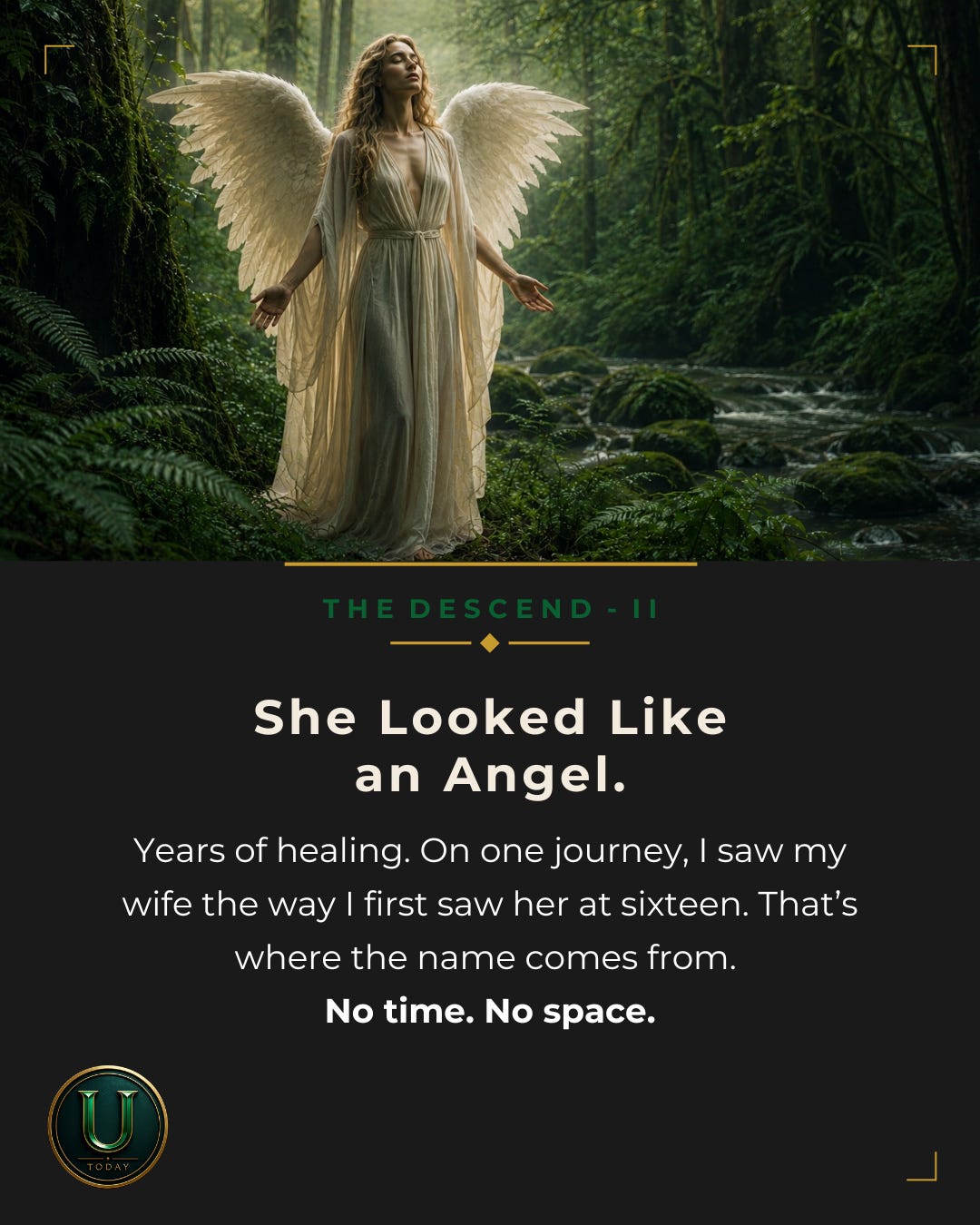
On my first DMT journey, I found myself in a conversation our souls had before any of this — my children, their mother, and me — the contract we made about the lessons we came here to learn. And when I looked up and saw her, their mother, standing there with our children, I saw she was an angel. It took me all the way back to the very first thought I ever had when I met her: she looks like an angel.
That’s where the album’s name comes from. No time, no space. All I was filled with was love for her and forgiveness for both of us. We had completed something — becoming parents to those two beautiful souls. So my body exhales, and I feel all of it in my heart.
If someone only ever hears this one album and nothing else of yours, what do you need them to walk away knowing?
That they were worthy of the rain before they did a single thing to earn it. We go looking outside ourselves for validation, for love, for acceptance — when it’s an inside job first. Settle the inside, and the outside falls into place.
There’s a song here that holds that whole idea for me, “The Man I Came to Meet,” and it returns on my next record as “The Man I Came to Meet (Reborn)” — the same truth, fuller. The song keeps becoming what I’m becoming.
I want every parent, and my own children most of all, to know they are never far from me. I love them from near and from afar. Always available. Always theirs.
What’s the one sound on this record — one instrument, one breath, one word — you’d defend against anyone?
The solo handpan that opens “The Jungle Remembers,” arriving alone before any chord. It’s the sound of something old that already knew my name. I find myself returning to that track more than any other. The jungle is my thoughts, my soul, my heart, my energy — it’s a transcendent song for me.
There’s also the one I made honoring my own father for Father’s Day, and a handful of tracks here that pull me up out of the chair — that make me want to stop working and dance around the room with my husband when I’m home with him.
— ◆ —
This album closes a spiritual year that began in July. What is that — and how long has July been the door?
As far back as I can remember — a decade, easily — my year doesn’t turn in January. It turns in July. The seventh month; seven, the number of spiritual attunement. Every year it sets the tone for the soul growth coming. July is my North Star. That’s the song “July Knows”: every year my July finds me.
This year the question was clear: am I worthy of it all. Anything I could imagine was already mine to receive — the deeper work was learning how to be available to it. Pristine health. Love and adventure with my husband. Clients I get to walk beside on their healing. And it’s the year I finally answered a lifelong yearning to become a recording artist. It isn’t how I pictured it — it rarely is, and usually that means it’s better than I planned. I’m learning that the voices in my head are often the guidance I’ve been ignoring. Lean in. Get curious. It’s been magical.
What was happening in your life the season this album arrived — the part that isn’t in the liner notes?
I wasn’t planning another album. There had been a thought for a few months about making something for Father’s Day, but what really sparked it was a visit. My mom came down to Mexico to spend time with my husband and me, and she told me about a dream she’d had of my dad standing on a dock. She’d felt his presence so intensely in my home.
My husband and I both feel our fathers close by often — they died the same month and the same year in August of 2014. Which still moves me, because September 16th of 2020, my husband (to be) and I both arrived in Mérida, Yucatán — same day, same year. The album grew out of that doorway.
What did you almost not put in — the line or feeling you nearly edited down because it was too true?
The spoken pivot in “The Boarded Door.” I’m sorry. Please forgive me. Thank you. I love you. I said it to my children, I said it to their mother, and at last I said it to myself. For a long time I thought it was too naked to release — that it belonged in a journal, not a song. Leaving it in was the entire point of the year.
I feel free now to tell one of my darkest hours, and exactly how it felt. Since that day in 2016, my mission has been suicide awareness — it’s what my speaking has been about, from my Global Possibility talk to my TEDx. What saved me was curiosity, and being truly listened to by my best friend Dana — getting out of my own head, being heard, being seen. I wanted my music and my speaking to finally say the same thing.
If I never speak from a stage again, the songs live in homes and hearts in ways I can’t imagine. I hope this one reaches the man holding it together, the queer kid, the child estranged from a parent — or the parent estranged from a child — and gives them one more reason to stay curious, because ten minutes from now everything can change.
Life is a roller coaster.
Stop bracing against it.
Put your hands up and let yourself be held.
— ◆ —
This record lets survival and sweetness live in the same room — “Worthy of the Rain” sits a few tracks from a New Orleans parade. Where does the pleasure end and the meaning begin, or do they refuse to separate?
They refuse. “Home Found Me” is for my husband. I’m home wherever we are together — safe, loved, and knowing he feels the same. All our searching, conscious or not, led us home to each other. Every relationship before prepared us to finally express love freely, in how we are together and in everything we build. The sensual and the sacred wearing the same skin. My body knew abundance was pleasurable before my mind would let me call it holy.
Describe the sonic world the way you’d describe a place. What does it feel like to stand inside this album?
It’s a forest at first light that opens into an ocean by the end. It starts near silence — handpan and breath — then moves through reggae sunlight, a supper-club swing, a full orchestra, and lands on a second-line parade strutting down the street. I deliberately refused one uniform sound. It was a struggle at first, and then I fell in love with the range of it — every vocal I love, and the heart of the lyrics laid bare. It’s me letting one listener — my mother, my children, a stranger at 2 a.m. — know me intimately. I’m honored by that exchange.
What did your body know about this album before your mind caught up?
That it was a single arc, not a playlist. I love storytelling, and my albums tend to move this way. But this one opened a window I’d kept shut — onto my own suicidal ideation, onto the love I carry for my children, and onto my gratitude for their mother and the two beautiful souls we were entrusted to raise.
— ◆ —
There’s a way to carry something heavy without ever naming the edge. “The Boarded Door” goes near the worst of it. How does this album hold someone without frightening them?
By never staying in the dark — only passing through it on the way to the door behind the door. The song opens claustrophobic and bare and resolves into morning; the key itself lifts when the forgiveness lands. It carries the tragedy and the triumph at once, and it doesn’t move in a straight line. It’s no time, no space — life happening in every direction at once, our souls maybe living it all right now in dimensions we can’t see.
The green dragon came out of a DMT journey guided by a shaman, where I saw myself as this enormous, beautiful, powerful, loving green dragon. When I looked into the mirror, the dragon was me and I was him. It was one of the most beautiful experiences of my life — unforgettable, like stepping into another part of time and space to meet a part of yourself you hadn’t met yet. The dragon doesn’t burn the world down. He finally lets it rest.
This album’s deepest purpose is to give people reasons to stay. Where is that purpose hiding in the music itself?
In the word worthy, sung so softly you could almost miss it. If you can convince one person they were worthy of the light before they earned it, they stay. That’s the whole mission, coded into a fingerpicked guitar.
Who were you writing this for — not the audience, the one person?
Tammy, their mother. Andrew, my son. Makayla, my daughter. People ask for the one person, and the truth is, it was always the three of them. Every song kept finding its way back to that table.
— ◆ —
Track 13 is a Mardi Gras parade that’s also the encore of a year that nearly ended you. How do you build something euphoric AND serious without one canceling the other?
You let the joy be earned, not pasted on. “The Soul Remembers (Swing It Reprise)” is a mash-up of the whole album’s journey — the living part, the part that gets to celebrate being alive right now, today, in this body, on this earth, in this life. It’s only allowed to be that joyful because the record already went all the way to the floor first. The party doesn’t deny the dark. It’s the proof you survived it.
Where on this album are you most powerful AND most tender in the same breath?
“The Dock.” My father as a guardian of my path — his strength and his love as a pure soul, the man who gave me life, asking nothing, offering only acceptance. It’s the most muscular image on the record: a Marine in dress blues saluting his family from the threshold of the other side. And it’s a benediction whispered through tears. Strength and surrender in a single salute.
The album argues you can be fully alive and fully aware of the cost of being alive. Where does that tension actually live in the music?
In “The Dream Changed Shape.” I thought I was building one life — life was building three. For years I thought my gift was to be a hands-on healer, a teacher, a coach. But my original soul desire was always this: music, words, the power a song holds. A song from another artist can carry me into a million journeys, and I want to do that for someone else — to say how I’ve felt my whole life in a language that reaches past speaking. Awake to the cost, and grateful anyway.
— ◆ —
People hear “spiritual album” and assume they know what it’s worth. What do they get wrong?
They expect something weightless — affirmations with a melody. But we are souls in human bodies, spirit and energy and frequency, more than we can imagine. For me, there’s no line between spiritual and not. Even my next record, a trance-house dance album for suicide awareness and the queer community, is deeply spiritual.
This one holds an estrangement, a near-bottom, a father on the other side, a forgiveness earned over years. The peace on it isn’t the absence of the wound — it’s what grew over it.
Abundance isn’t the spa version. It’s what’s left standing after you stop arguing with grace.
What label — on the music, on you — no longer fits, and what did you have to refuse to outgrow it?
I’m a Pisces, and I’ll happily accept all the variations of that one. But I no longer fit the label that I’m broken, that something is wrong with me, that I’m unlovable. The thoughts still arise from time to time — I’m not pretending they don’t — but now I recognize them. Like children, or like little demons in my head, I acknowledge them and then invite them to sleep. I don’t make them wrong. I see the old thought, I thank it, and I put it to bed — let it sleep deep in the cave.
What part of yourself is in this album that the world usually doesn’t let a man like you show?
Being at home — with my husband, and inside myself, wherever I am. “Worthy of the Rain” is a man admitting out loud that he wants the light and isn’t going to apologize for it anymore: the stars don’t ask permission to be what they were made to be. Men aren’t supposed to say they’re at home in their own skin, worthy of all of it, without flinching. I said it for five minutes straight over one guitar.
— ◆ —
When someone you’ll never meet plays this at 2 a.m. on a night that’s gone wrong — what do you want it to do for them?
I want them to feel the thread between us — that in that moment, the one who made the song and the one hearing it are the same. I want it to sit down beside them the way life sits down beside me in “What Grew Naturally,” smilin’ like old friends do. You’ve carried enough now. You don’t have to earn your way back to worthy. There’s a door behind the boarded door, and it’s already opening. Stay long enough to walk through it.
What does this album make possible that a speech from a stage never could?
Combining the musical journey with the stories I share on stage lets me connect in a way that speaking alone doesn’t always allow. A stranger can play a song at full volume, alone, at the exact moment they need it, a hundred times, forever — and never have to ask anyone’s permission to be held. The music is the stage that’s always open. A speech ends. A song waits by the door.
If this is the only album of yours someone ever hears, what do you want it to have told them about staying?
That they were never broken — they were becoming light. That the dream changing shape is not the dream dying. Make your life epic. Be curious about all of it, but mostly about you and your own experience. You can change your thoughts, your heart, your mind. Listen to your heart curiously, with compassion, with deep love. The soul remembers what the mind forgets: you were worthy of all of it, before you ever opened your eyes this morning.
“What if I lived to prove them wrong — not that they were wrong about me, but that the way I’d been living was not the best version of who I was becoming.”
No Time, No Space is out now, released June 11, 2026.
Listen and follow us here: [ LinkTree / Spotify destination ] ·
If this conversation touched something heavy: in the US, call or text 988 (Suicide & Crisis Lifeline). Outside the US, findahelpline.com lists free, confidential lines by country.
— ◆ —
UNTAMED TODAY · UNTAMED Talks · Self-Interview · The music is the stage. The interview is the door beside it.