
What the Wall Knows
Pearse is fifteen. She painted two hundred and sixty feet of a children’s pool and hid a private grief inside the color where no one would ever find it.

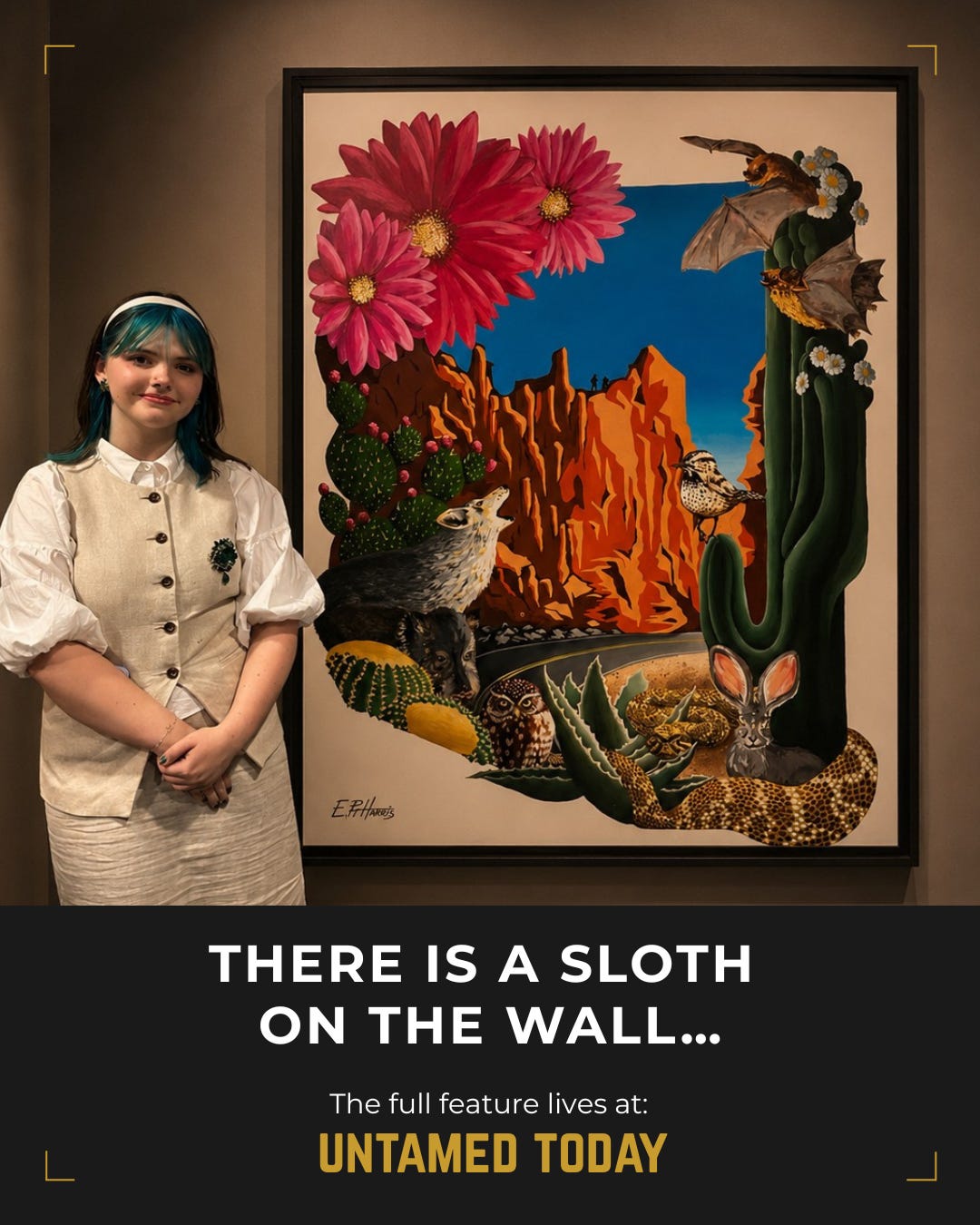
There is a sloth on the wall, and almost no one knows it is there. It sits in silhouette across two hundred and sixty feet of what used to be a flat, gray, uninviting surface at the edge of a swimming pool, a wall children walk past without slowing, the way children walk past most things adults have decided are finished. They do not know that the animal was someone’s favorite.
They do not know that the person it belonged to is gone, that he was young, that he is no longer here, that his parents and a grandmother helped buy the paint now drying on the cinderblock.
They only feel, if they feel anything, that the room is brighter than it was. That is exactly what the maker intended.
She did not put the sloth there for them. She put it there for the three people in the world who would understand it, and then she said nothing, and then she let the rest of us live inside its color without ever explaining the weight underneath.
Her name is Pearse. She is fifteen.
When you ask her to describe herself without mentioning the award she won or the mural she painted, she does not reach for any of the words a publicist would hand her.
She thinks for a moment, and then she says she is a curious person who likes to observe things, and that when she observes them it makes her want to draw them. An observer.
She offers it almost as an apology, as though it might not be enough. It is, in fact, the most precise artist’s statement most adults will never manage to write.
ORIGINS
Her mother is a numbers person, by her own account — the other side of the brain, she says, watching her daughter from across a divide she has never quite been able to cross.
She tells the story the way you tell a thing you have turned over in your hands for years and still cannot fully explain. Pearse was two. She got hold of a box of Q-tips from somewhere, and she laid them out across the floor — not in a pile, not in a line, but in scenes: houses, a whole city stretched across the room.
She wore jewelry, but never the way it was meant to be worn, a necklace hung down her back instead of her front, everything a half-turn off from intended. Where did this come from, her mother kept thinking.
She herself had never once looked at an object as anything other than the thing it was for. Her daughter had been quietly rearranging the meaning of objects since before she could spell. The talent was not announced.
It was simply already there, in the way a child laid out cotton swabs on a floor.
"She is fifteen and she already refuses the clean version of her own story. That refusal is the rarest thing in the room."
There was a fish, too, drawn in crayon at two or three, that actually looked like a fish — an angel fish, her mother decided, and framed it. Recently she showed Pearse a drawing of her own from the same age: a scribble. This is what you made, she said, and this is what I made. The difference was not effort. It was a way of seeing that one of them had and the other simply did not, and both of them know it, and neither of them makes too much of it. That is the tone of the whole family around her gift — impressed in the best possible way, protective of it precisely because they refuse to inflate it.
DISCOVERY
What surfaces in conversation with her is not precocity, which is cheap and everywhere, but a kind of structural honesty about her own work that you rarely hear at any age. Ask her about the competition she won — the one that put her name beside Bob Ross’s — and she will tell you, unprompted, that she expected it to be judged and it turned out to be voted on, and that she is not sure all the art was weighed equally.
She won, and she is still telling you the part that complicates the winning. She is fifteen and she already refuses the clean version of her own story. That refusal is the rarest thing in the room.
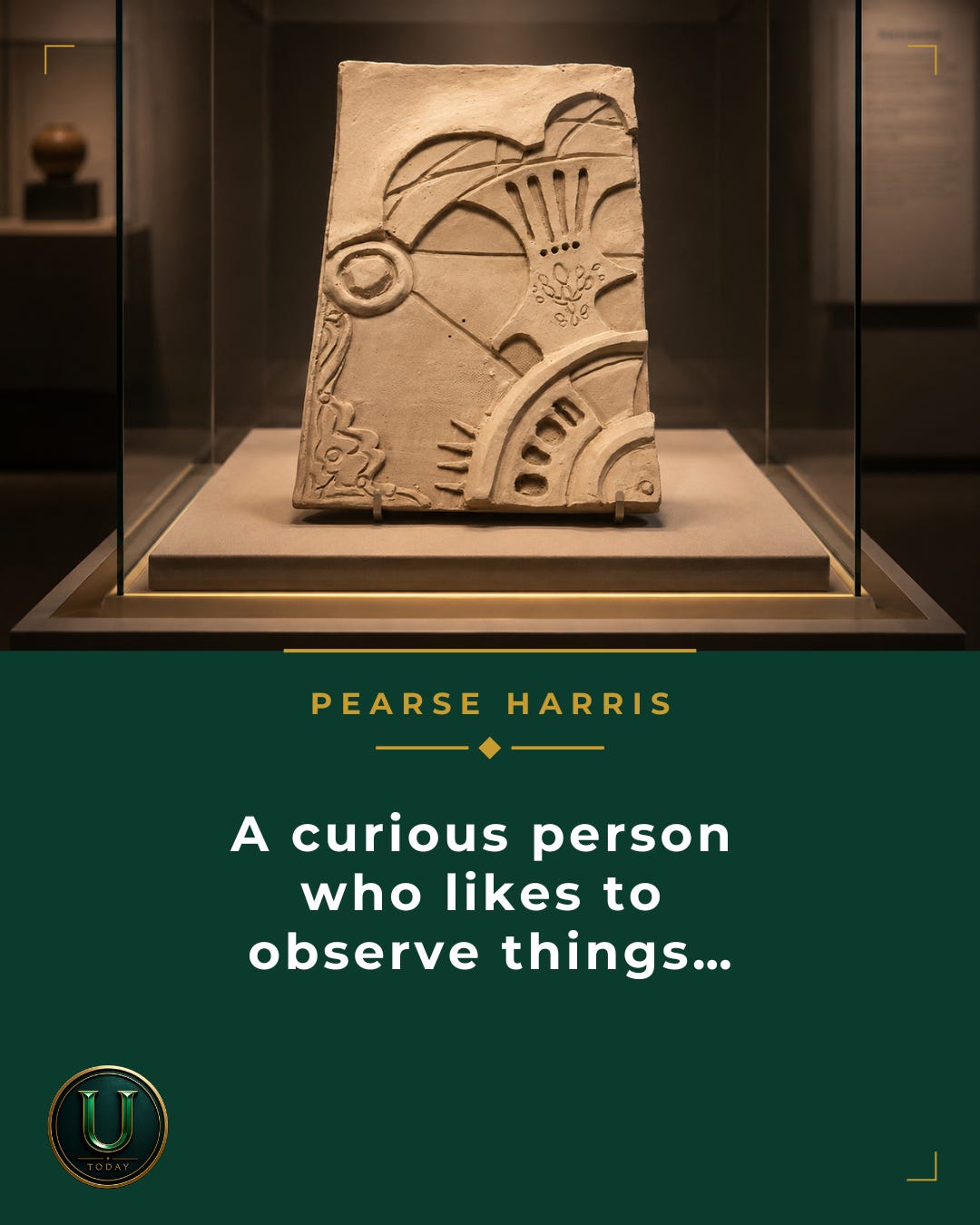
She works in everything. Oil and acrylic, ceramics thrown on a wheel at a community center every Tuesday with her father beside her, crochet built stitch over stitch under the lamp in her bedroom, oil pastels, spray paint, pencil, digital.
The instinct of every industry that meets a young artist is to make her choose one — to ask what she really is, as if the answer to a person could be a single medium.
She has already declined.
She figured out, somewhere in the last two or three years, that her art did not have to hold to one style or one material or one theme, that it could be wildly different from itself and still, underneath, be unmistakably hers.
She is now working on the harder version of that problem, the one that occupies serious artists for decades: how to be that varied and still recognizable. She named it without being asked. Most people twice her age cannot.
The crochet is the clearest evidence of how her mind moves. Her grandmother crochets; for years she tried to pass it to Pearse, who would learn it and then lose it, learn it and lose it, until one Thanksgiving the two of them sat down together and it took. After that it was not gradual.
She came home from the trip able to look at any crocheted thing — a stitch, a finished piece — and see, instantly, how it had been built: take it apart in her mind, understand the pattern, and reproduce it without ever following one.
Her grandmother still writes the steps down and counts the rows. Pearse glances and knows. She does not learn patterns. She reverse-engineers them in her head and moves on.
DEPTH
Press her on what is actually the same across three forms that demand completely different things of the hands, and she does not hesitate: patience, and presence. With clay you observe or you throw it off center and it collapses.
With a portrait you observe or it stops looking like the person. With crochet a single missed stitch unravels the whole. The word she keeps returning to is the word she used to describe herself — observing — and you realize she is not describing three hobbies.
She is describing one discipline that happens to wear three faces.
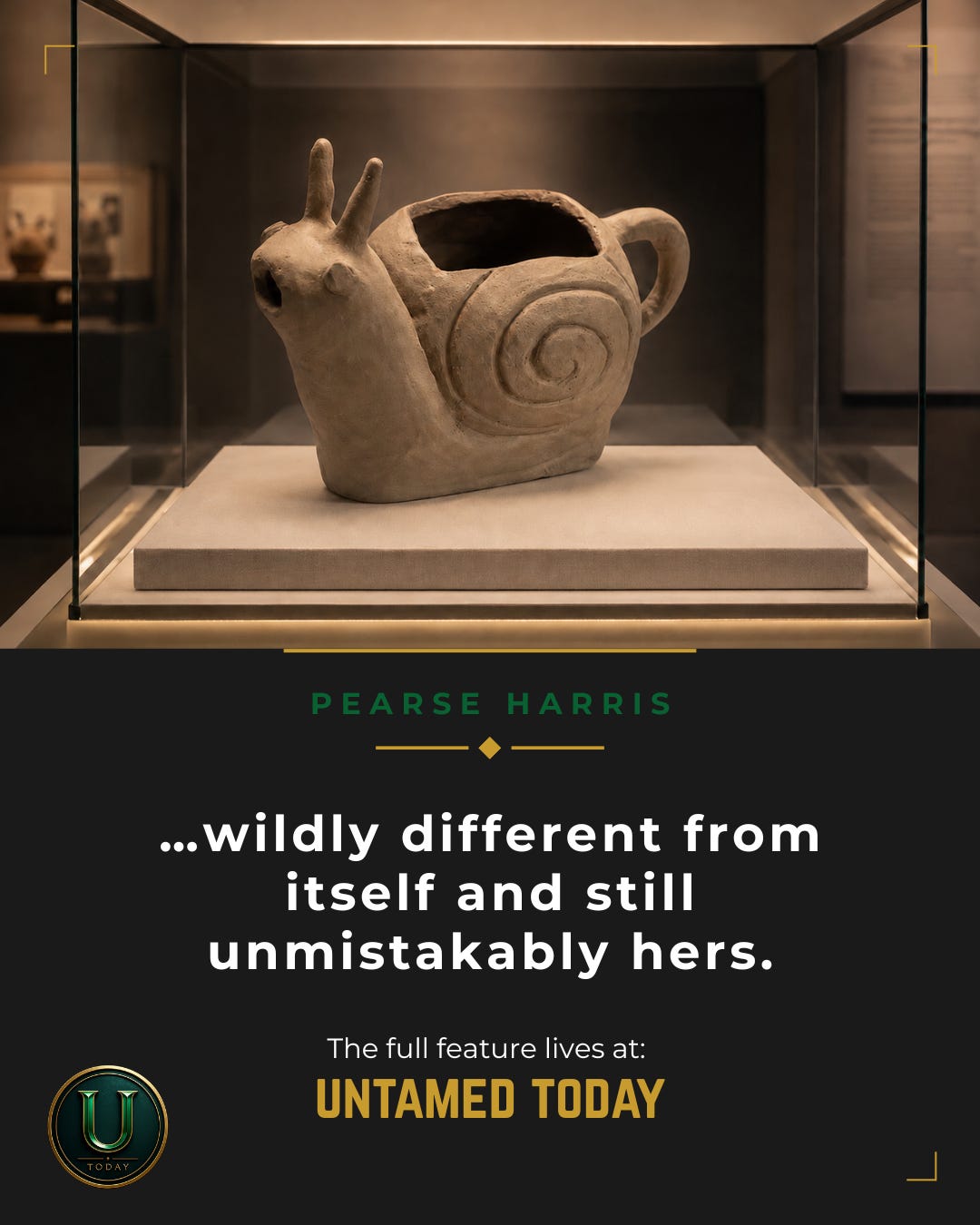
Ceramics, she says, is the one that gets closest to her, because it asks for the whole body: not only the hands and the mind but the arms, the legs braced to steady the arms, the full animal of her bent over a spinning thing.
Painting, the medium she is publicly known for, is the one that fights her hardest. She says both of these in the same breath, without flinching, and there it is — the thing the brand exists to find, the powerful and the tender held in one hand: a maker confident enough to name her best-known gift as the one she trusts least, and unbothered by the contradiction.
"Play in one hand, prayer in the other and she does not see why she should have to choose."
She is, by her own quiet account, a slow painter. She likes to take her time. She had to learn to step back from a canvas that would not become what she saw, to walk away from it and return with different eyes, and sometimes to start over entirely, to accept that the thing she made was not good enough and that she could do better, which is a sentence most adults spend their lives constructing elaborate defenses against ever having to say.
She learned it doing commission work, painting a portrait of a friend’s late cousin, restarting his face because a portrait probably ought to look like the person. The discipline arrived dressed as obligation.
That is usually how it arrives. She talks, too, about the play in it — painting as the place she can be careless, jerk a brush across a passage to blend it fast, ruin a thing and rescue it — against ceramics, which she calls closer to prayer, the medium that will not let her be anywhere but exactly here.
Play in one hand, prayer in the other, and she does not see why she should have to choose.
THE WALL
The mural was the turn. Two hundred and sixty feet across three walls of a YMCA pool — a back wall, a left wall, a right wall — that the director described to her standing in the chlorine air and then promptly forgot he had asked for all three.
She remembers being overwhelmed by the sheer quantity of surface. She remembers being afraid of two things, and they are revealing things to be afraid of at fourteen: that it would take too long and block the way for the people who needed to use the room, and that they would not like it. Not that she would fail — that she would inconvenience.
The fear of a person already thinking about the others before the paint is even open. It was not a family friend or a relative who first made it feel real, she says, but a lifeguard at the pool, a stranger, who wanted to see what she would do with the wall. Something about a person with no reason to be kind being curious anyway.
There were days she did not want to go. Her father drove her out after school and they painted for hours and she went home and fell into bed and did it again. Paint in her hair, paint on every pair of jeans she owned.
Her mother, watching, made sure the world knew the unglamorous truth underneath the headline version: there were two whole months, a burnout in November, finals and the holidays in December, when Pearse did not touch it at all, and everything still got finished on time, because the point was never the grind.
The mother’s instinct, the whole way through, was to stand between her daughter and the pressure: you always have time to see your friends, make that time, do not do the burnout thing to yourself.
The point was that she kept thinking about the children who watched her work, the ones who walked up mid-brushstroke and asked, astonished, whether she had really done all of this, and asked her what her favorite flower was. She had not expected them to notice. She finished the wall for them.
Now she goes back and watches people pass it. Some stop and call it fun. Most do not notice it at all, and she has made a strange peace with this that takes most artists half a career to reach: the not-noticing is also the point. The room is simply brighter now.
"The deepest thing you make can be the thing no one sees, and the work is most alive precisely when it has stopped being about you."
The wall is part of the environment, part of the ordinary air of a place where someone might arrive having a hard day and leave a half-degree lighter without ever knowing why, without ever knowing her name.
She wants them to feel that somebody put effort into something for them. That somebody, walking past, is thinking about them. She is fifteen and she has located the exact thing she wants her work to do in the world, and it has nothing to do with being seen.
WHAT SHE REFUSES
The adults around a gifted young person tend to say the same well-meaning thing, and she has already heard it enough to be tired of it: you have to do something with this. She does not entirely disagree, but she knows it is wrong for her, and she can say why.
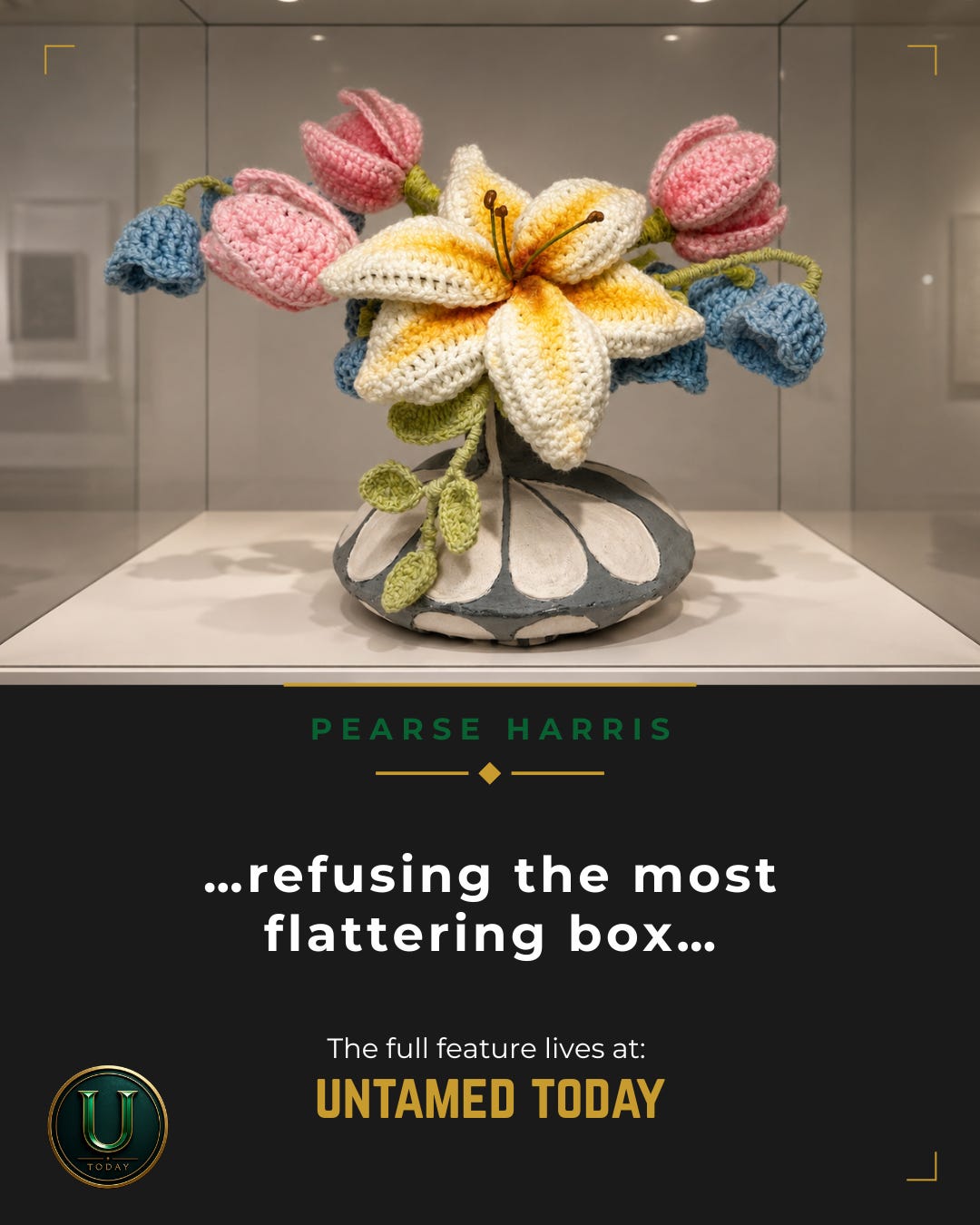
The moment she begins to look at her art as a future, a career, a thing she is obligated to monetize, she feels the passion drain out of it — it stops being something she wants to do and becomes something she has to. So she is refusing the most flattering box anyone has tried to put her in.
She does not want art to be her job. She wants it to remain the thing that is hers. She loves science too, picks up its concepts faster than her mother can read them twice, and she intends to keep all of it. She will not be reduced to a single gift any more than she will be reduced to a single medium.
This refusal has a longer history than the art does. In the first grade, when her grades were not what they could have been, her mother said something gentle about doing better, and Pearse looked at her and said, plainly, that school and tests and grades were a made-up thing, not real life, and that she was doing really good at real life, so maybe back off.
Her mother, to her enormous credit, eventually agreed. The advice that changed everything came from an uncle who had been the same kind of child: stop trying to mold her, follow her lead, let her show you where she wants to go.
They did.
They stopped steering and started watching, protecting the curiosity instead of correcting it.
Pearse did not like school until this year, and her mother is convinced that had they pressed harder, made the gift into a program, it would have become a constant fight and the love might not have survived it.
There is a vase in the family’s living room, on the shelves built into the wall where the photographs live. Pearse made it in her first ceramics class.
She was hand building it for the pleasure of a shape she liked, and somewhere near the neck of it she realized she was making a flower vase, and the realization turned into a gift.
It became her mother’s, and then months later, on Christmas Eve, into the small hours and through Christmas night, she crocheted flowers to fill it, one of them her mother’s favorite, finishing them between the obligations of a family holiday because she had decided they would be done.
The whole family kept stopping to watch her hands move. The object began as play and resolved into love without her ever quite deciding to make it happen. That is how most of what matters in her work arrives. It evolves. She does not force it.
PRESENT-TENSE ALIVENESS
Something has shifted in the last stretch of time that was not true two years ago. She has only recently started taking painting seriously, only recently started throwing on the wheel, a few months, she says, since she finally understood how to cone the clay up and down and center it, and the day she understood it she made nothing at all and counted it among her most fulfilling days, because she had learned.
A successful day, for her, is a day she learned something or a day she failed in an instructive direction. She painted fabric for the first time the other week, folds of cloth on a portrait, and was startled that it was not as hard as she feared.
She had simply wanted to see whether she could render the folds, and she could.
In September her work goes into a museum, and she is already building pieces for it that her mother, who watches her daughter pull an art-historical style out of nowhere and reassemble it in her head, having never taken the class, cannot always follow. She describes one such painting as a different take on a seventeenth-century still-life tradition built around mortality, abstracted away from the still life into something stranger.
She is fifteen. She offers this the way another teenager might mention a playlist.
MEANING
Ask her what she would tell another young maker too scared to show their work, and the answer is not encouragement. It is strategy, delivered plainly: show it, because that is when you learn the most.
The feedback is the point. Sometimes the most useful eye belongs to a non-artist, she says, because they see it without the artist’s flattering knowledge of what you were trying to do, they see what is actually there.
Don’t be afraid to share, because that is when you grow. There is no version of that sentence that sounds like a fifteen-year-old. There is no version that sounds like coaching, either. It sounds like someone who has already metabolized the hardest law of any creative life and decided to live by it out loud.
What she protects now, having been recognized for one bright thing, is the meaning underneath the rest, the private weight she folds into a piece and does not narrate, the way she folded a beloved cousin’s favorite animal into a children’s pool and walked away.
The cousin loved sloths; he had given to the work of saving them; after he was gone, his parents and her grandmother put money toward the paint, and so she set his animal into the wall in his honor and told no one it was there. She wants the freedom to make something that means everything to her and nothing announced to anyone else.
She is keeping a room for herself inside her own work. It is the instinct of a real artist, and she has it at fifteen, before anyone has had the chance to talk her out of it.
CLOSING
Her mother does not see a straight path ahead of her, and does not want one. She sees something that twists and turns, a daughter who connects with people easily and will keep evolving, who will not stay in one place, and the most a parent who loves her can do is sit close and watch where the curiosity leads.
It is the same thing the family has been doing since the road trips — all fifty states, hikes and national parks and, in every city, hours spent hunting down the street art, walking the murals until the light went, teaching three kids that the plains of one state and the hills of another were each worth stopping for.
The eye that found the sloth was trained on those walks. When you ask Pearse what she wants the work to do, stripped of the award and the wall and the September museum, she does not reach for legacy. She wants to make it brighter. She wants to be a part of someone’s ordinary day, to exist alongside them whether they notice or not.
Which returns us to the wall, and the sloth, and the children who will never know. The animal is still there, holding its private grief in plain public light, asking nothing, explaining nothing, brightening a room full of people who came to swim.
This is what she has understood that most makers spend a lifetime refusing: that the deepest thing you make can be the thing no one sees, and that the work is most alive precisely when it has stopped being about you. She is fifteen. The wall already knows more about her than the award ever will.
UNTAMED TODAY · COVER FEATURE · CULTURE & IDENTITY
The Quiet Invitation
— ◆ —
Pearse made something that brightens a room whether anyone notices or not. That’s the whole brand in one sentence.
We’re always looking for the next one — the artist, the founder, the maker who’s been doing the real work quietly. If something in you recognized something in this, that’s not an accident.
→ Tell us your story. [DM Jesse] · or apply at the link in bio.
For inquiries, commissions, or press regarding Pearse’s work,
Contact through her parents: Neil Harris · @Neilcharris82 or @jac_ryan
Artwork @Pearse.harris — shared with family permission. @harrisartstudio1
UNTAMED TODAY · For people who refuse to live edited-down.